

It’s probably no surprise that as a teacher of English I’m passionate about language, about its use and abuse, about how it can lift us up, cut us down, betray us and expose us. Shared language can become a powerful shorthand by which we can reconnect with one another and reiterate shared values and intent. It can also become intensely irritating, particularly when the shorthand becomes so short that it no longer makes sense to an outsider – and even moreso when as an ‘insider’ it’s clear nonsense. It happens, and it’s a pet hate of mine. However, as a woman of complete contradictions I also hate pedantry (not the word, the concept) and as a result this often goes unchecked when I notice it. I just don’t need to bring my thoughts on every matter to the table every time, particularly if they appear to challenge or tear down something that has a meaning for others – and yet if I ignore that still small voice too often, I lose the thread of myself a little, and become inauthentic, detached, and at worst cynical. For me it can be a form of checking out, of quiet quitting, even within a job that I love, feel fortunate to occupy and am motivated to do well.
Becoming alert to your internal monologue and its potentially capricious nature is something that can help a great deal.
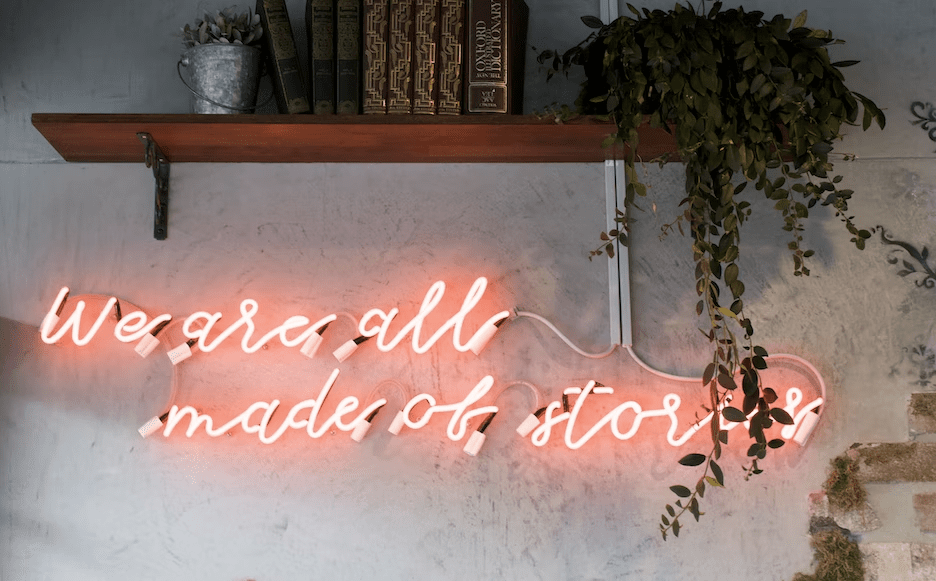
The stories we tell to ourselves about ourselves are critical, and yet sometimes we are completely uncritical of them. We fail to recognise, sometimes, that we are prone to generosity on some fronts and spectacularly harsh on others, and we fail to recognise the dynamic nature of those very stories. There is power in a truth spoken; and the same tale can be told differently on different days and to different audiences. The most damaging narratives are those we don’t articulate for fear of isolation and judgement, for fear of showing vulnerability or of being misunderstood. Sometimes they lie untold on the cavernous pit of our stomachs because they are lurking, undetected, and we feel only the effects of them in insidious, visceral ways. Sometimes they are locked in our chests and we are only too aware of their presence, and yet any word of them can only be uttered in strangled sobs. Sometimes they are itching to leave us, clawing to get out, and yet our tongues loll idly in the way.
Often it is not an invitation to tell a story that we need: it is a connection and an environment that teases it out. It is up to us to play our part in creating those environments and within them the relationships which draw out the untold tales, sometimes in fragments and confused extracts that we construct aloud together: a conversational jigsaw with pieces that fit and half-fit, rotate, are cast out and later found and slipped into perfect place. Early years teachers are expert at creating the environment and relationship that allows our youngest children to learn, to experiment, to be drawn along through a route which is at once assessment and pedagogy, to have agency and choice and to be noticed. The very best of these teachers are brilliant conversationalists, by which they are able to prompt thought and dialogue, and to listen intently for it. We need to do this for ourselves as learners and leaders, and to do it for one another – because when we learn through narrative, and we learn to construct narrative, we are forever changed by our mastery of our words and the manner in which they show us and shape us.
Perspective changes so much and perspectives can be created by time, position or distance. Standing close to an oak tree, it’s clear to see the ripples and rivulets of the bark, the places where it has worn away, the scars and marks and areas of decay, home to creeping insects and soggy moss. We may be blind to the canopy overhead and the role the tree plays in the skyline. We may appreciate only part of its wonder. Taking a walk for a few kilometers may change our perspective on the tree: we may see its strength and structural significance as it stands bold against the sky. As seasons pass and bring with them the obvious changes, so years add to the tree’s solidity and as it sits, squat on the hillside, withstanding the elements and providing shelter, shade and habitat, we are just as blind to the roots that reach down and tell another story altogether. Space, distance, time all affect our perceptions of, and our narrative about the tree.
And so it is with ourselves. Others’ narratives about us will be affected by their perspectives and those will change, in all likelihood, according to our relationship over time and in proximity. Our narratives about ourselves are powerful and problematic. Sometimes they can be fixed, stuck on repeat, retold and retold in spite of a changed reality. “I always” and “I never” keep us there. Sometimes it’s important to suspend the narrative, to not know what to say, to let the words of the story float around us, unattached, disordered, adrift. Taking the time to left them spin and settle, allowing them to take shape, is an important part of caretaking ourselves and something few of us do with any regularity.
It’s important to remember: our inner monologue belongs to us alone. The voice inside us is sometimes the least listened to, the most influential, and the one that we can neither escape nor lose. Cherishing this inner voice, choosing to feed it with positive words and allowing ourselves to listen to its kindness in return is one of the best ways we can take care of ourselves – and as we tell ourselves and others our stories, let them be the kind that we will want to re-read, to re-tell, to re-live.
I have one wild and precious life, one soulful inner voice, and many, many opportunities to use it well. This means I need to take time to listen to what my inner voice is saying, and to allow that narrative to develop independently.
I am also designed to be in relationship and part of something bigger than myself. This means I need to be generous to others with my time and with my thoughts, being prepared on occasion to construct my narrative aloud with them, and to provide a platform for others to do the same. This is how we demonstrate and foster belonging. This is how we enable one another to navigate trying circumstances, and to work out what to do and how to be, when we don’t know what to do or how to be. This is how we realise our own agency.
Listening to others’ stories is one of my greatest joys and telling my own has been instructive, difficult and joyous almost in equal measure. We need to be better at creating the environment and relationships where we can tell stories and use them to better understand ourselves and each other: we have libraries yet to discover ahead.
 Appshot
Leave a comment