
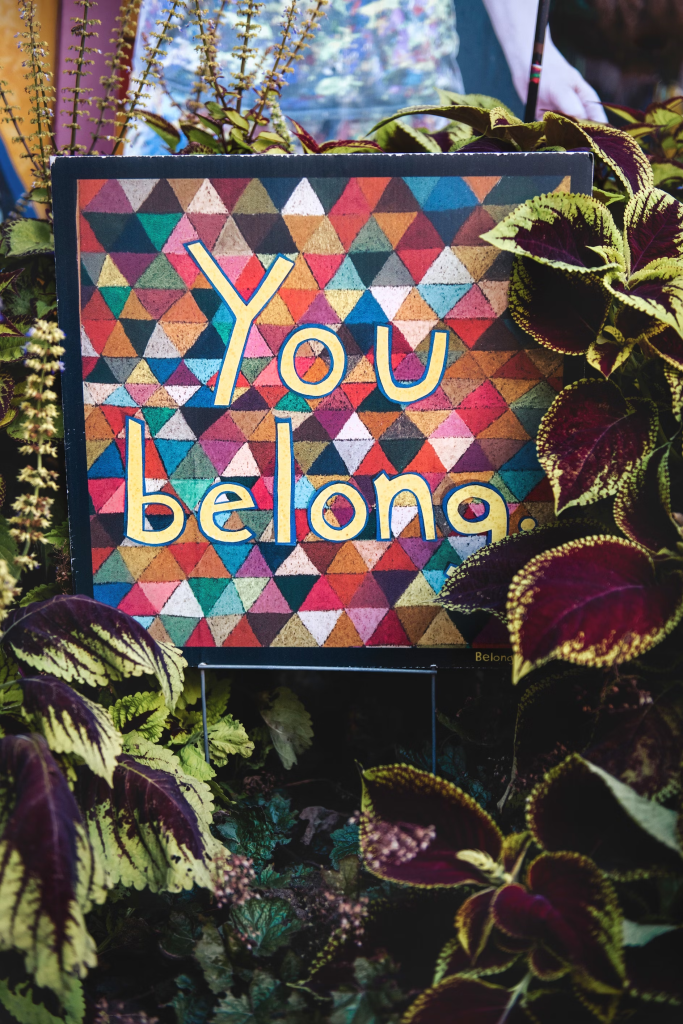
We belong in a bundle of life. Ubuntu says: a person is a person through other persons. It says: I am human because I belong.
Archbishop Desmond Tutu
Irrespective of a child’s background, abilities, sensibilities or disposition, a sense of belonging is critical. Identities matter to us and a large part of construction of identity is about what is ‘self’ and what is ‘other’ – this fairly primitive level of identification underpins an enormous amount of our social interaction, organisation and belief, sometimes in constructive ways and sometimes in ways which are damaging. Alongside creation of identity comes social affiliation and group membership; around and beyond this is a deeper and more visceral need to belong.
When the need to belong is unmet, it is difficult – perhaps impossible – to thrive psychologically, and potential goes unfulfilled. This is itself is a concern. However for some children, the desire to belong to something or someone can lead to the most extreme forms of violence and criminal and sexual exploitation. When you’re in a gang, you feel belong. When someone older is giving you gifts and attention and affection you belong – even if you belong also to his friends and associates.
School culture is driven by and served by a sense of belonging, from the uniforms we expect our children to wear to the learning families, teams and houses we establish. The greater affiliation and pride our children have in their ‘belongingness’ to school, the greater their commitment to the norms of expectation we espouse and the more likely they are to act with contrition and to seek reparation when they stray from these. Their sense of belonging can help them to make strong decisions in the first place, but when they make mistakes, it is their sense of belonging that will ground them and bring them back as prodigals, knowing they will be supported to recover, to do better and to again engender pride in others as well as feeling it for themselves. As school leaders, we face challenge in helping some of our most vulnerable young people to know this deep sense of belonging, and we have numerous opportunities to either confer or confound it with the decisions we make.
We have the chance to create more inclusive settings where children aspire to and meet our high expectations with support, and we can develop this first by asking them and then by measuring ourselves on the action we take in light of their responses. The work of Carol Goodenow from the 1990s explores the extent to which a sense of belonging affected the school experience of US high-schoolers. Using her simple questionnaire and Psychological School Membership Scale, we can find out so much about what individuals and groups feel about their school and the extent to which they feel they belong. By analysing responses we can pick up potential mental health and well-being concerns for individuals, patterns and trends for particular demographics and student groups, and themes across our settings which link to decisions we have made as leaders. If, for example, there is a strong sense in a school that adults listen but that peers don’t – and this is consistent across different demographics and different students – then we know that there is work we need to do on increasing respect amongst students, perhaps through more focused teaching of oracy and communication skills. If few students agree with the statement “people here notice when I am good at something” this may be a sign that the rewards’ culture and use of praise in the school needs work. If this more strongly correlates with the experience of children living with disadvantage, this could be a salutary indication that more time and effort needs to go into noticing the strengths and accomplishments of these students and letting them know that they have been noticed.
Before and alongside use of Goodenow’s scale, we can use climate data to help us with some hypotheses. By looking at attendance data and those who are more persistently absent than others, we may glean insights about the individual students and the extent to which they feel they belong. If within this group there is a prevalence of one ethnicity, or one particular demographic – those with SEND, for example – there may be credence in the concept that this group feel less of a sense of belonging in school, and this should be explored with them. The same can be said for exclusion and internal sanction data and for rewards information. By reviewing the demographic make up of the students that engage in different clubs and enrichment activities, we can have better insights into those who have a strong sense of belonging and an awareness of who may not – again by individual, demographic or student group. For a reflective senior team, this information is rich with possibility – and the vey act of asking students through the survey may increase a child’s sense that they “matter here”.
When our children do not see themselves reflected in the aspirations of the school, it will diminish their sense of belonging. For children who live life as part of a minority or marginalised group, this confers their sense that they do not belong here. Seeing themselves, or “people like me” noticed, revered, used in displays and marketing material, in text books, on screens and in powerpoint slides, is a vital part of telling children they belong even when we are saying nothing. In truth, it’s impossible for us to say nothing – we are either telling a child they belong with our actions and choices, or we are telling them that they do not, because representation matters. It is our job as adults working with young people at arguably the most impressionable time of their lives to ensure that they know that they belong in our schools, and this is something we do with our language, with our tone, our manner, and our choices.
I heard recently of a discussion several years ago in a school about a change of uniform. During the discussion the governing body were asked to consider what their stance would be on the colour of hijab that girls should wear if they chose to wear such a head covering to school. After some discussion the group decided that they would not prescribe a colour at all, as this was an area that they wished to respect and to leave to individual choice in relation to religious freedom. However, the message received by at least some of the girls concerned was that the school did not care what colour hijab they chose. By failing to bring this aspect of the children’s identity within the uniform policy, the governors unwittingly denied the young women an opportunity to belong – this vital aspect of their identity was considered not to be the school’s business and there was an unintentional othering in the decision. Uniformity is not everything, but when we make it clear that we care what children wear to school – because it denotes their ‘buy in’ to our values and because our ‘botheredness’ denotes our care for them. Here, tone is everything. It is easy to have a strict and obnoxious policy which sees children routinely sent home for minor uniform misdemeanours without support. It is equally easy to have sky-high standards with stellar support, where children are expected to be in full uniform and sensitively supported to reach that standard every day, whether through lending or giving uniform, or working with families to ensure conformity. In my time as a school leader, the signs that a child was struggling rarely occurred first in the classroom; they were far more often visible on entry to the school where either by choice or by circumstance, a child was not dressed in a way that showed they were ready for the day’s learning.
Belonging is so much more, though, than whether a uniform is worn with pride. It’s knowing that you are part of something bigger than you, or your family and that within it you have a special place. It’s understanding that others went before you and that their pages in the story were written so that you could author the next part. It’s understanding that traditions and rituals exist because there is a history that has led up to this moment – yours – and that there will be moments to come for others. Understanding your place in a shared history and having both a reverence for what has gone before and an energy for what is to come is a deeply grounding, safe and confidence-building experience; one that is rarely articulated but profoundly important.
For ten years, on my school’s birthday, I was gathered with the rest of the thousand students to hear the Head Girl read the school’s history. “In 1882, Sir William Harpur, and Dame Alice, his wife…” is the way it began and is etched into memory. At the time it seemed distant and odd to listen to the detailed history of the school, including a flood that saw the headmistress arrive at school on the top of a lorry, and a series of dates when different buildings were opened. However it contributed to my understanding that, as much as I was a creator of my own destiny, I walked the halls that others had walked and I would succeed as others had succeeded. I loved school, and definitely felt that when I spoke it mattered, and that I was worth listening to. There will have been many factors which contributed to that sense, but I can be sure that it was an intentional culture created by the adults around me for expressly that purpose. As a headteacher, I aimed to provide the same sense of belonging for the students in my care.
To know that we belong is important to us all to be able to thrive in our work and socially. “To feel a sense of belonging is to feel accepted, to feel seen and to feel included by a group of people, believing that we fit in, trusting that we will be protected by them. To not feel belonging is to experience the precarious and insecure sense of an outsider.” Owen Eastwood
The challenge we face as school leaders is how to understand the extent of our students’ belonging, and how to increase it with our daily interactions and decisions. Every single day, our philosophy has to line up – what are our goals and standards, what are our values? How have our decisions lined up with our values today? These are the questions we must ask ourselves as school leaders, in order to challenge ourselves to make life better, day by day, for all the children in our care.
There is more to discover about how a child’s and a cohort’s sense of belonging can be increased, and the strategies we might employ as school leaders and engender in our wider teams. The greatest gains are likely to be for those who currently dart in and out of the margins; those experiencing disadvantage beyond school; those who have had adverse childhood experiences; those suffering trauma; those in care; those at risk of harm. What children in these circumstances need is high ambition and high standards matched with the highest levels of support, a sense of being known, and of having many, many people in their corner. When children are suffering, our ability to say “You don’t have to do this alone” is immense – but first we have to notice, and they have to be known to us. Knowing our children well demonstrates our respect and care for them – to create environments and relationships that tell our children “you belong here” will instil confidence and self-belief. For most it will be the mark of a good education, for some children, it will give the foundation upon which they will later discover their best self. For a small number – those most at risk and most in need of us – it will be life-saving. For this reason alone, as leaders we need to become scholars of belonging and dealers in hope.
 Appshot
Leave a comment