
Equity can really only be achieved once expectations are clarified and need is revealed. Equity focuses on giving everyone what they need. This might be equipment, uniform, skills, language – whatever is lacking should be provided, either solely by the school or jointly with families, so that each child can access all that a school environment can offer for them. Equity sits both alongside and in contrast to concepts of fairness.
Fairness in the eyes of some is about having the same approach with every child; for some children fairness lies in all having the same rewards and consequences. In this respect, equity can be seen as the enemy of fairness. However, nothing can be more fair than determining levels of support based on levels of need, and levels of need become apparent from a setting and articulation of a standard.
Equity demands of us that we re-evaluate ourselves and our expectations – equity at work should prick our conscience and cause us to reflect. “Is this difference I see in need exposed by an expectation that is fair and helpful? Is there bias at work, and if so, what needs to change?”
Equity highlights for us where resource should be targeted, and where advocacy should begin. We might articulate a reasonable standard, we might provide all that is needed to meet that standard – but does the gap between the need and the standard demand us to take action beyond our school? Is there a community need? A policy failure? We can and should aim to resolve the issue in the short term in the interests of the child: we can and must use our influence as civic actors to address the issue in the long term in the interests of the community’s children.
There is a famous image relating to equity:
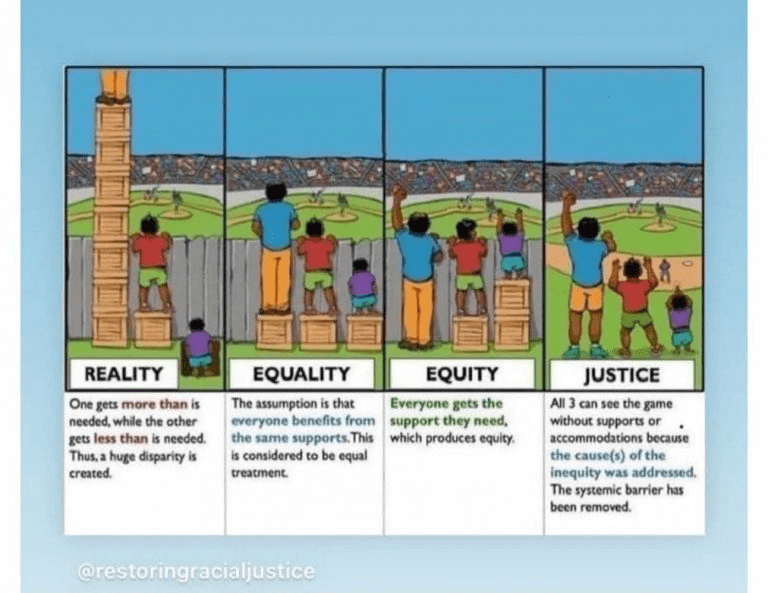
It’s not perfect, but it’s helpful in some ways. In our example, the tools available to schools might be the boxes, but the main barrier – the wooden fence in this case – may be something beyond school. As civic actors it is incumbent upon us to act to remove the fence whether it be in our school, in our school system, or in our community. Equity drives the conscience of the values-driven leader.
 Appshot
Leave a comment