
School improvement is everything all at once. It is both a process and an outcome; the work of education experts and that of professional services; it is a culture and a mindset and it is also a range of very practical and pragmatic decisions. ‘Making good decisions together’ is a mantra that came to characterise the work in our trust following the global pandemic and has proven to have a resilience of its own: we believe that schools improve through the convergence of numerous good decisions, made between Principals who are trusted and empowered to lead their schools appropriately to context, and Executives who have perspectives, experience and expertise that offers the kind of support and challenge in decision making, the occasional intervention and the propagation of strong practice that enables the Trust Dividend to be realised. We believe in the primacy of Principals to lead their schools effectively according to context: however, we recognise that doing so alone is significantly less effective than in collaboration with others. Our leadership curriculum focuses deliberately on developing our abilities to make good decisions together in context, applying theory and evidence in the pursuit of consistent delivery of excellent educational experiences for the communities of which we are a member.

In the Cabot Learning Federation we have a range of school settings and a model of school improvement that has evolved over time to be risk-informed but not risk driven, to have numerous standardised elements designed to ensure excellence; and areas of alignment and empowerment beyond this. The balance of standardised, aligned and empowered elements maintains flexibility for colleagues to have genuine agency and to experience joy in their work, within frameworks that set out both what excellence looks like and how to consistently achieve it.
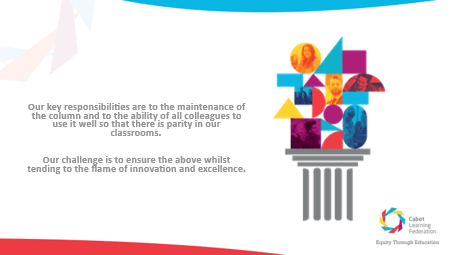
We have come to refer to these elements as being part of our ‘pillar and flame’ where the pillar represents areas of standardisation led by experts to ensure excellence and the flame represents the creativity and innovation that true empowerment brings. Some areas of the pillar are simple: matters which when applied consistently enable us to live out the high expectations to which we aspire. Though these matters may be technically simply or cognitively straightforward, they can nonetheless be areas of challenge in terms of consistency. Many other areas in the pillar are the domain of professional services and involve the careful ordering and simplification of complicated technical processes. Educationally the pillar includes our 2-19 curriculum, our assessment and processes of analysis, our systems for safeguarding and our approaches to leadership development. This work has enabled significant meaningful collaboration and the improvement of practice and provision in every classroom in every setting in the trust. The flame is predominantly complex activity which relies upon relationships, communication and includes intuition and creativity: elements of culture; the pedagogy of effective curriculum enactment; the meeting of student need; effective context-specific operational leadership. Critically, the role of central colleagues and educational executives is to ensure that schools at all stages of development are supported and challenged to benefit from both the models of excellence held, exemplified and propagated in the pillar and the flexibility and sensitivity to locality and context that is offered by the flame.
Our strength as a trust is achieved by mutual consent: collaboration is both an instinct and a conscious decision that we commit to in numerous ways every day, held together by the centripetal force of our shared endeavour, our commitment to our shared HEART values and our deep and ever-developing understanding of the lives of our children so that we can ensure that those experiencing disadvantage, those with additional needs and those that are structurally or societally under-served can enjoy the privilege of an excellent education. Our trust architecture is designed so that engagement is irresistible as opposed to relying on mandated collaboration: yet we do have a duty to one another that we take seriously and commit to traversing even when it is more challenging. We strive for inclusive excellence where we are inclusive by instinct and excellent by design, pursuing these aims and working on ourselves so that our resting levels of expertise increase and we move ever closer to being self-improving.
As a larger organisation, we must rely increasingly on clearly articulated methods, structures and ways of working. As a human organisation, we must invest intentionally in the kinds of interactions that rely upon and perpetuate the very best relational practice. Our strategy is about both what we do and the way that we do it. Our leaders work on domain expertise and who they are as leaders. Our educational support staff are supported to develop knowledge and the agency and expertise to apply it well. Our teaching team are given opportunities to curate, narrate and co-create the best learning experiences for each other and for our children and furnished with a curriculum, assessment and pedagogic model to rely upon and so ensure that they have access to the best fruits of collaborative endeavour.
One critical element in our approach to school improvement, and to trust improvement, is an understanding of the role of narrative and voice. How we talk to and about ourselves is a critical part of who we are and who we become. By intentionally telling the stories of our trust and our experiences as trust agents and ambassadors, we co-create not just our current understanding of ourselves but also iterate our next. We believe that conversations are not just critical to the work: oftentimes they are the work, and by intentionally creating space to have conversations about our practice, we motivate and inspire one another to greater heights.
 Appshot
Leave a comment